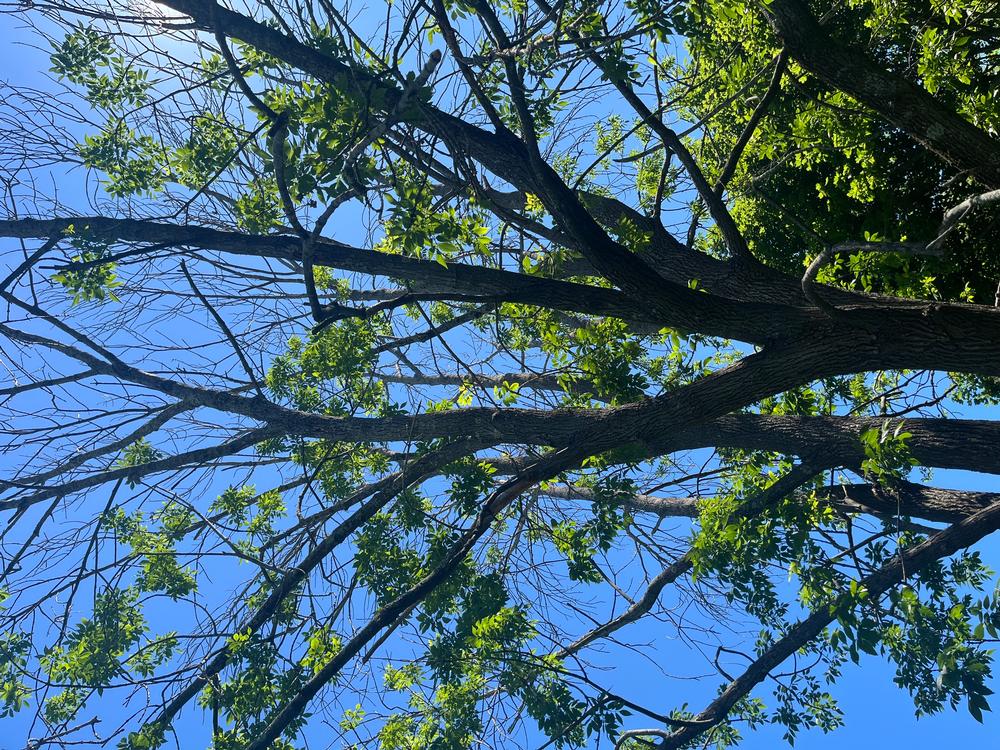
Beech leaf disease is caused by a tiny non-native nematode, Litylenchus crenatae mccannii, that lives in beech buds and leaves. All beech trees are susceptible, including American, European and Asian beech and the cultivars sold in nurseries, and trees of every age are affected.[1] It was first found in Maine in 2021 in Lincolnville and is now found in all of Maine’s counties.[1] As of July 2026, the Maine Forest Service counted 404 Maine towns with detected infestations.[2]
Stands of affected beech have been recorded across the southern half of the state, and damage is currently most severe along the Midcoast.[3] Portland is one of the 2026 sites where the Maine Forest Service is testing treatments.[3]
Symptoms of beech leaf disease
- Dark bands between the leaf veins, easiest to see when you look up through the leaves
- Cupped, deformed, shriveled or undersized leaves
- Thick, leathery leaves
- Leaves dropping early
- Aborted buds and sparse foliage
- A thinning canopy
These symptoms come from the Maine Forest Service.[1] Many trees decline over several years as bud and leaf damage builds up.
Treatment options
All beech leaf disease treatments are still experimental.[1] These are the options described by the Maine Forest Service and the Connecticut Agricultural Experiment Station:
The Maine Forest Service has been testing trunk injections and phosphite bark drenches at sites around the state, including Portland in 2026. So far the trials have shown mixed results: some trees respond well to one or both treatments, and others do not.[3]
When to treat
- May to AugustPhosphite bark drench, two applications about a month apart, repeated every year.[1]
- Mid-May to late JulyWindow for fluopyram foliar sprays.[4]
- Late June to AugustThiabendazole macroinjection. A late June or July treatment should limit symptoms for the following two years; an August treatment may reduce symptoms the next year.[1]
Is your beech worth treating?
Treatment makes the most sense for valued landscape and specimen beech near homes. For trees near structures or high-use areas, the Maine Forest Service says removal is worth considering, because decaying trees can become unstable. In woodlots, it does not recommend cutting beech pre-emptively, because some trees may tolerate or resist the disease.[1] A tree health assessment can help you decide which beech trees on your property are worth protecting.
Help slow the spread
- Keep infested branches and leaves on site; chip or burn branches and compost or burn leaves (an open burning permit may be required)
- Use firewood locally
- Avoid moving beech trees, seedlings or saplings
- Clean boots, tools and equipment before moving between sites
You can report suspected beech leaf disease to the Maine Forest Service at foresthealth@maine.gov or (207) 287-2431.[1]